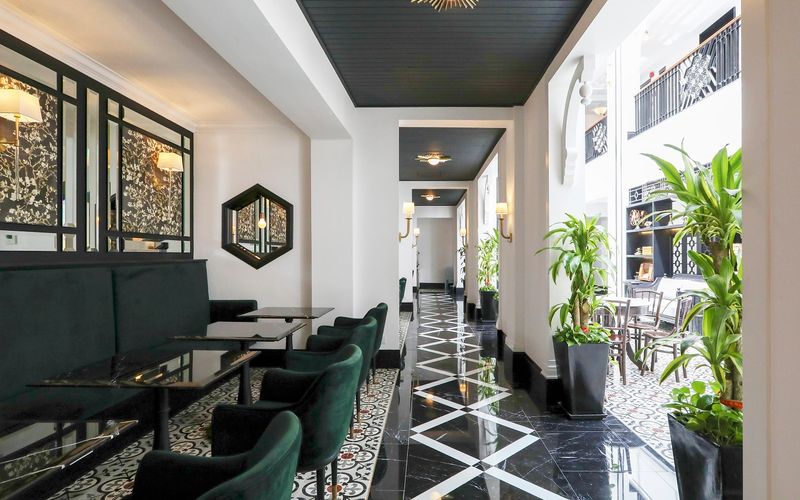
Liu Men Hotel
Six Peranakan 'doors' restored over three years into Malacca's jewel-box
Transparency
Why This Score
How each of the nine Heritage Hotel Index dimensions was evaluated.
Heritage & Authenticity
40% of HHIReview pending
Review pending
Review pending
Guest Experience
35% of HHIReview pending
Review pending
Review pending
Operational Excellence
25% of HHIReview pending
Review pending
Review pending
About the Property
Six heritage shophouses ("liu men" = six doors in Mandarin) painstakingly restored over three years by the Pang family. A blend of 1930s colonial Art Deco geometry with Peranakan cultural motifs, original floor tiles, and curated vintage artifacts.
Original Purpose
Six Peranakan family shophouses consolidated post-1945
Highlights
History Timeline
Malacca enters the Straits Settlements; the city experiences a revival of Peranakan merchant wealth and a new wave of shophouse construction as Chinese families invest in permanent commercial-residential properties.
Six adjacent lots on a Malacca heritage street are acquired by the Pang family, establishing a family compound of connected shophouses that will remain in the family for over a century.
The six shophouses are rebuilt in the Art Deco Peranakan style fashionable in Malacca during the 1930s, combining geometric Art Deco facades with Nyonya ceramic tilework and traditional Chinese courtyard interiors.
Japanese forces occupy Malacca; the Pang family vacates the six shophouses, which are used for Japanese administrative and supply functions until the liberation of Malaya in August 1945.
Malacca UNESCO inscription intensifies heritage tourism; the Pang family commission a three-year conservation study of the six-door shophouse compound with a view to adaptive reuse as a heritage hotel.
Liu Men Hotel opens after three years of painstaking restoration by the Pang family, preserving the Art Deco plasterwork facades, hand-laid Peranakan floor tiles, and the atmospheric six-door compound layout that gives the hotel its name.